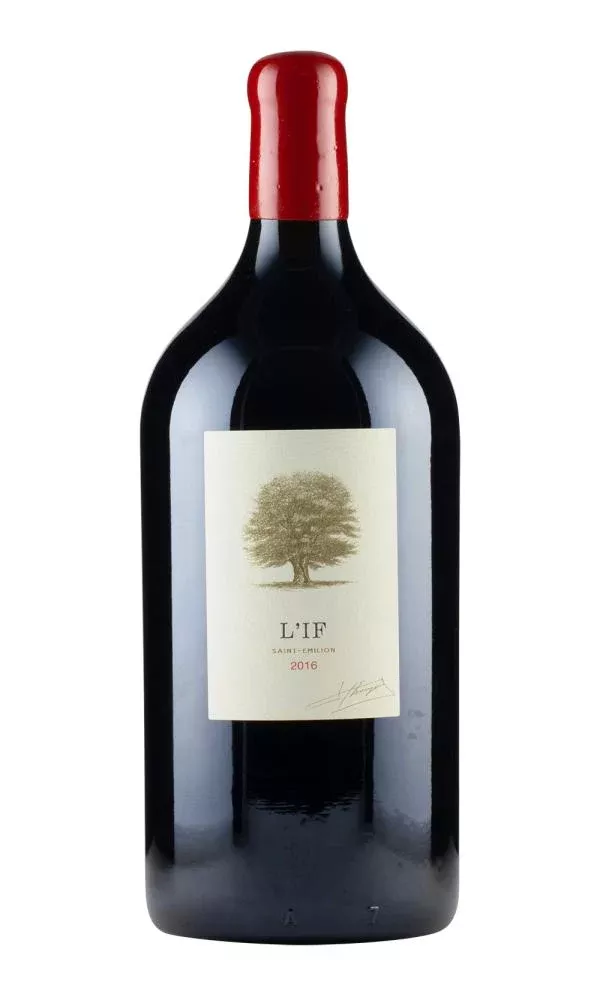
This is a compact cylinder of ripe and fresh fruit with currant, fresh-herb and dry-earth character on the palate. So solid. Full-bodied yet refined and checked in every way. Well-defined, formed and perfect.
Reviews:
- Vinous: The 2016 L’If, 100% Merlot in this vintage, is going to need a number of years to be at its very best. The allure the 2016 showed as a young barrel sample has been replaced with huge structure and prominent yet well balanced tannins that both give the wine its strong-voiced personality. Readers should be prepared to be patient with the 2016, as it is going to need a number of years to be at its very best. Even so, the 2016 is super-impressive in the early going, not to mention a fabulous wine in the making. Cyrille Thienpont gave the 2016 14 months in French oak, 50% new.
- James Suckling: This is a compact cylinder of ripe and fresh fruit with currant, fresh-herb and dry-earth character on the palate. So solid. Full-bodied yet refined and checked in every way. Well-defined, formed and perfect. Just a hint of volcanic salt and iron. Contemplate this one.
Producer Information
Château L’if can be found on the right bank of the Bordeaux in Saint-Emilion. In 2010, Jacques Thienpont bought the estate. Thienpont was already known as the owner of the world famous winery Le Pin in Pomerol. As with Le Pin, which means pine tree, once again nature was the inspiration for the name. L’if means yew tree, loosely translated from French. Before the takeover, when it was still owned by Michel Boutet, the estate was called Le Haut-Plantey and its wines were marketed under the name La Bouygue. At the time of acquisition, the winery covered five hectares of vines. This has gradually increased by another three hectares. The planting consists of 70% Merlot and 30% Cabernet Franc. This is divided over a number of separate lots. Previously, the plantations also consisted of Cabernet Sauvignon, but these vines have been replaced by Cabernet Franc. The soil consists of limestone with a clay subsoil. The vinification starts in temperature-controlled stainless steel tanks. The wine is then pumped into French oak wooden barrels, 50% of which are new. The wine stays there for a period of 12 to 16 months. The first vintage appeared as early as 2011 and consisted of only 14,000 bottles. Because the Cabernet Sauvignon plots were replanted with Cabernet Franc, some parts of the land lay fallow and only came back into production after a few years. That is why the production numbers from 2014 to about 2020 were low. In 2014, for example, only 6,000 bottles were bottled. Despite the fact that the winery has only recently started in its current capacity, the wine is certainly a strong contender at the absolute top of Bordeaux! The best vintages of Château L’if are: 2015, 2016 and 2018.