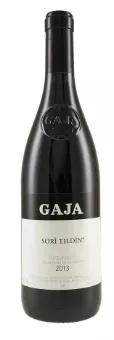
The Gaja Sori Tildin displays deep purple color in the glass accompanied by complex aromas of toast, minerals, sour cherries, cedar and spices.
Reviews:
- Wine Advocate: The 2013 Barbaresco Sorì Tildìn sees fruit sourced from a vineyard site located directly above Costa Russi. This fruit is harvested at 260 meters above sea level, while the latter is located 30 meters lower in elevation. The age of the vines is slightly younger as well, with 45-years-old being the average age. That subtle change in vineyard location does much to shape the generosity and bounty of the bouquet. There is a distinct softness and roundness here that comes forth as dark cherry, pressed blackberry and plum, with tobacco and leather in a supporting role. This Barbaresco stands on solid feet with tight textural richness that comes exclusively from the Nebbiolo grape. Breaking with past tradition, Barbaresco Sorì Tildìn is made with a single variety.
- James Suckling: The perfumes are fabulous here with strawberry, walnut and procini mushrooms. Mountain herbs. Full body, tight and integrated tannins and long finish. Refined and beautiful.
Producer Information
Gaja is one of the best-known wine producers in all of Italy. Originating in and still based in Barbaresco, in northwest Italy, the Gaja name remains most strongly associated with Nebbiolo-based wines, though the company now makes more wine in Tuscany than Piedmont. The business was founded in 1859 by Giovanni Gaja with just two hectares (five acres) of vineyards in Barbaresco. Each generation saw expansion, although Angelo Gaja, who took over full-time in 1970, is often credited with the estate’s more recent success. He was responsible for overseeing sweeping changes in the vineyards and cellars, and introducing the famed single-vineyard Barbaresco wines Sorì San Lorenzo, Sorì Tildìn, and Costa Russi (now Langhe DOC wines). These changes were not always well-received: famously, the name of the Darmagi Cabernet Sauvignon translates as ‘what a pity’, referring to Angelo’s father’s regret over the introduction of Bordeaux varieties. Gaja is famous for having introduced Barbaresco wines to a wider audience and for modernizing Piedmont – introducing international grape varieties and winemaking practices more common in Bordeaux or California. However, traditional elements remain, such as long macerations and the use of larger oak barrels (albeit in combination with new barriques). The estate generated significant attention when it began to blend a small amount of Barbera into all but two of its Barbaresco and Barolo wines, relegating them to the Langhe DOC classification. Angelo Gaja insisted this was a traditional practice to correct acidity, and at any rate, the label focused on the vineyard name, rather than the appellation. Gaja’s move beyond Barbaresco started in 1988 with the acquisition of the Sperss vineyard in neighboring Barolo. In 1994, Gaja took over the 27 hectare (67 acre) Pieve Santa Restituta estate in Montalcino, followed by the 118 hectare (290 acre) Ca’ Marcanda estate in Bolgheri. The name of this estate, acquired after protracted negotiations, translates as ‘House of Haggling’. Although Angelo Gaja has never announced his retirement, the company is run in conjunction with daughters Gaia and Rossana.